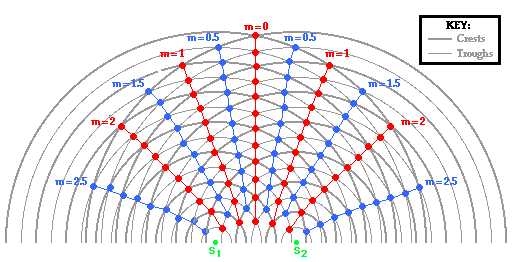
Ex 3B, p. 57-62, Two Point Source Interference (Double Slit Experiment)
Beats
two waves of a similar frequency (similar wavelength) superimpose to come in and out of phase causing constructive and deconstructive interference respectively. This causes a warbling/beat sound of frequency (fb) equal to the difference in respective frequencies
fb = | f1 - f2 |
Wave Beats
Easy Beats- Physics
Doppler Effect
The Doppler Effect: what does motion do to waves?
Doppler Effect
Intro to the Doppler Effect
Doppler Effect Observed Frequency Equation
Sonic Boom
Two Point Source Interference
Antinodes - Path Difference = n𝜆
Nodes - Path Difference = (n + 1/2)𝜆
Two Point Source Interference
n𝜆 = dsin(𝛳)
n: Antinodal Fringe Number
𝜆: Wavelength (m)
d: Slit-Spacing (m)
𝛳: Angle between Fringe on screen from the central position line
Iff 𝛳 is very small, then
n𝜆 = dx/L
x: Distance from Fringe on screen to central position (m)
L: Distance from slits to screen along the central position line (m)
Wave-Particle Duality Applied to the Double Slit Experiment
Particle displacement in the medium is parallel to the direction of wave propagation e.g. sound waves, primary earthquake waves
Transverse Waves
Particle displacement in the medium is perpendicular to the direction of wave propagation e.g. light and other electromagnetic waves, secondary earthquake waves
Frequency - Period
Sound Waves
Superposition of Waves
Waves travel through each other and the total amplitude at any moment is equal to the sum of amplitudes of the individual waves.
Standing Waves
In musical instruments - when a reflected wave travels back through itself causing fixed points of Nodes (Deconstructive Interference) and Antinodes (Constructive Interference) due to the fractional relationship between the wavelength (𝜆) of the wave and the length (L) of the resonating chamber
in musical instruments - when a reflected wave travels back through itself causing fixed points of Nodes (Deconstructive Interference) and Antinodes (Constructive Interference) due to the fractional relationship between the wavelength (𝜆) of the wave and the length (L) of the resonating chamber