Showing posts with label E = mc2. Show all posts

Tuesday, 21 February 2017

Term 1 Week 4 2017

Homework

  • Activity 12 A, p.194, Mass-Energy Equivalence
  • Activity 12B, p.100-200, Nuclear Reactions
Nuclear Reaction E = mc2

Nuclear Chemistry Part 1

Nuclear Chemistry Part 2


Binding Energy per Nucleon

Binding Energy per Nucleon is a negative energy or a debt of energy. This is the amount of energy it would take to liberate a nucleon from the nucleus. This energy was originally radiated off when the nucleus formed.

The energy radiated off, the Binding energy, is lost energy and comes from mass that is lost by the nucleons. Mass per Nucleon shows what is left over once a bound nucleon has radiated away some of its mass.

Fission:The breaking up of a larger nucleus into smaller daughter nuclei. Anything above Iron will radiate off energy.

Fusion:
The joining of smaller nuclei into a larger nucleus. Anything below Iron will radiate off energy.


Fission & Fusion


Fission


Monday, 22 February 2016

Term 1 Week 4

E = mc2

Homework 

  • Activity 12A Mass-Energy Equivalence, p.194
  • Exercise 10 Modern Physics, p.189-198 - Workbook - This will be assessed.

Nuclear Reactions


E = Δmc2

Radioactive Isotopes

PhET Applications:

  • Nuclear Fission https://phet.colorado.edu/en/simulation/legacy/nuclear-fission
  • Alpha Decay https://phet.colorado.edu/en/simulation/legacy/alpha-decay
  • Beta Decay: https://phet.colorado.edu/en/simulation/legacy/beta-decay
  • Models of the Hygrogen Atom https://phet.colorado.edu/en/simulation/legacy/hydrogen-atom
  • Photoelectric Effect https://phet.colorado.edu/en/simulation/legacy/photoelectric

Nuclear Fission


Nuclear Fusion


Nuclear Power Station


Monday, 15 February 2016

Term 1 Week 3

Photoelectric Effect HW Activity 11B Question 2

Answers here 
https://docs.google.com/spreadsheets/d/1EaI_cdL1JgvaCk-aJgZrT4daDv1da5AB3ZcRN_XutiM/edit#gid=0

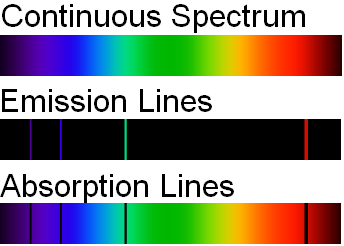
Atomic Line Spectra

Hydrogen Emission and Absorption Spectra for the visible Balmer Series


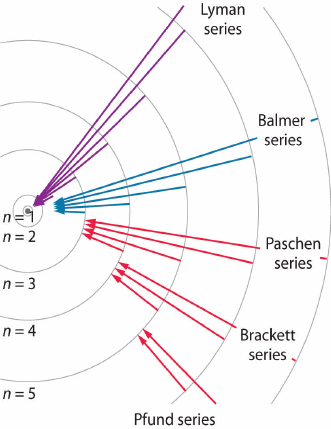
Hydrogen Emission Spectra for each Series and where they come from


Working with the Rydberg Equation

1/λ = R(1/S2 – 1/L2)

λ: Wavelength (m)
R: Rydberg Constant
R = 1.097 x 10⁷ m-1
S: Series Number
L: Line Number

L > S


Bohr Moderl Of Hydrogen Atom


Homework

  • Activity 11C, p. 183 Text. Spectral Lines
  • Activity 11D, p. 188 Text. Atomic Energy Levels

Nuclear Reactions

Conservation of Energy-Mass E = mc2